



Governance as Infrastructure
BBYMI was not created to fund projects alone.
It was created to build governance-backed capital systems.
We believe durable institutions require durable capital and durable capital requires disciplined
governance.
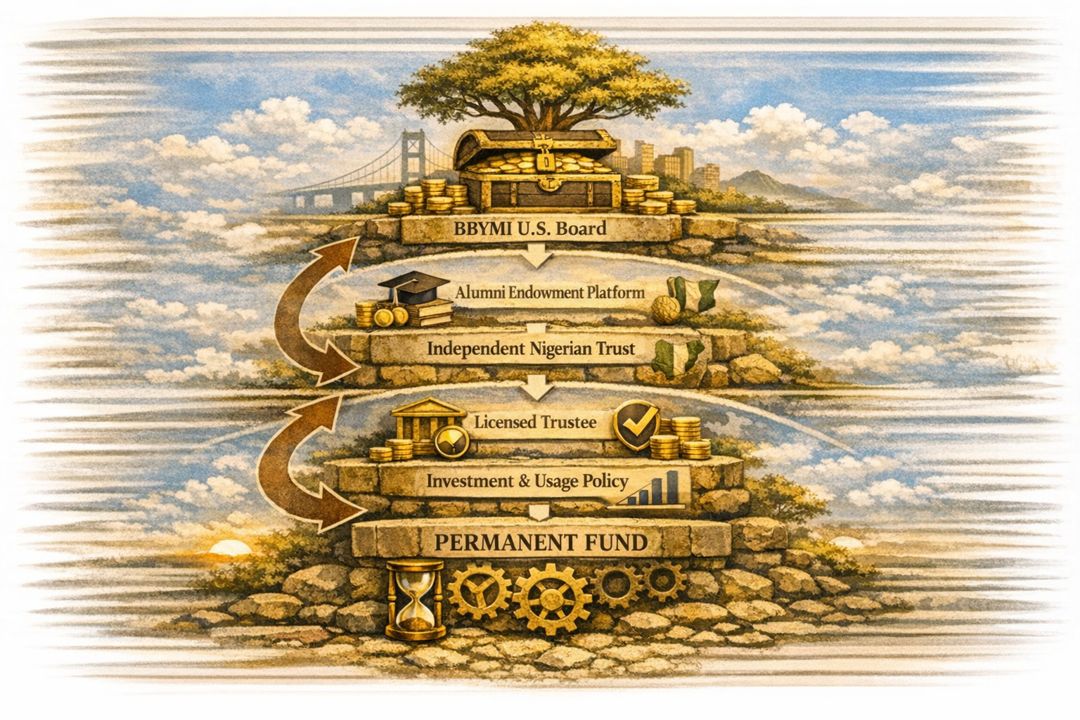
Governance-Led. Trustee-Backed. Structured for Permanence.
Builders of Bridges Across Young Minds Initiative (BBYMI) operates under a governance
framework designed to ensure capital preservation, fiduciary oversight, regulatory compliance,
and long-term institutional durability.
Our model separates fundraising, governance oversight, and fiduciary asset management to
protect endowment principal and maintain public trust.
1. Structural Overview
BBYMI’s governance architecture is built on clear role separation:
BBYMI U.S. (501(c)(3))
Provides platform design, donor stewardship, compliance oversight, and reporting to U.S.
stakeholders.
Alumni Endowment Platform
Facilitates structured alumni participation and capital aggregation.
Independent Nigerian Trust Structure
Constituted under applicable Nigerian law to hold and preserve endowment corpus.
Licensed Trustee
Appointed to provide fiduciary custody, investment administration, and compliance oversight in
accordance with the trust deed and applicable law.
Investment & Usage Policy Framework
Formal policies govern capital preservation, permitted investment strategy, and income
distribution rules.
This structure ensures that capital raised is governed by policy, not personality.
2. Capital Preservation Mandate
BBYMI endowment funds are structured with a permanent capital philosophy:
● Principal (corpus) is preserved in perpetuity.
● Only investment income may be deployed for approved academic programs.
● Distribution decisions follow pre-approved usage policies.
● Trustee oversight protects against erosion of capital.
This approach converts episodic donations into enduring institutional assets.
3. Fiduciary Oversight & Trustee Independence
Endowment assets are held under the supervision of a licensed trustee operating within applicable legal and regulatory frameworks.
Trustee responsibilities include:
● Custody of assets
● Investment administration consistent with approved policy
● Recordkeeping and reporting
● Compliance with trust and fiduciary obligations
Trustees operate independently of alumni contributors to ensure objective capital stewardship.
4. Investment Governance
Each endowment structure adopts a formal Investment Policy Statement that defines:
● Permitted asset classes
● Risk tolerance parameters
● Liquidity requirements
● Performance monitoring standards
The objective is prudent capital growth while safeguarding long-term sustainability.
5. Income Usage Policy
Annual distributions of investment income are governed by written usage guidelines that
prioritize:
● Grants & Scholarships (merit and need-based)
● Teacher development and academic excellence initiatives
● Institutional strengthening and infrastructure support
No distributions may be made from principal. Distributions are only made from a program
disbursement reserve that is funded by investment income from the Capital fund.
6. Compliance & Regulatory Alignment
BBYMI operates in alignment with:
● U.S. 501(c)(3) nonprofit governance requirements
● Applicable state charitable solicitation regulations
● Anti-money laundering and sanctions compliance standards
● Nigerian trust and corporate regulatory frameworks
Cross-border fund transfers are executed through documented grant oversight procedures.
7. Transparency & Reporting
BBYMI is committed to transparency through:
● Annual reporting to donors and corporate partners
● Documented endowment performance summaries
● Governance disclosures
● Conflict of interest safeguards
● Independent financial recordkeeping
Transparency strengthens confidence and institutional credibility.
8. Governance Principles
Our governance framework is guided by five core principles:
Durability – Capital is structured to outlive individuals.
Integrity – Fiduciary responsibilities are clearly defined and respected.
Separation of Duties – Fundraising, oversight, and asset management are distinct.
Accountability – Reporting and compliance are embedded in operations.
Scalability – The model is designed for replication across institutions.